Cute Retro Study Stationery Icons
When I’m scouting for a new machine embroidery design, I’m rarely looking for just something "cute." I’m looking for viability. Can this design hold up in production? Will it read clearly on a finished product? Does it have the visual weight to justify a price point for my clients or my own shop? Recently, I’ve been evaluating a set of Cute Retro Study Stationery Icons, and while they initially strike me as simple Illustrations, my experience suggests they are far more versatile than their minimalist aesthetic implies.
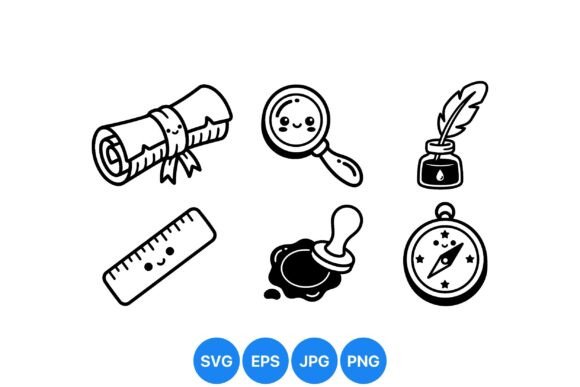
These aren’t your typical complex floral arrangements or intricate character portraits. They are adorable kawaii style vector icons in black and white featuring smiling stationery items such as a scroll, magnifying glass, ink quill, ruler, compass, and wax seal. The playful and charming nature of these graphics makes them an intriguing candidate for embroidery project work, provided you understand how to translate flat vector lines into stitchable assets.
The First Impression: Mood and Market Fit
The immediate appeal of these icons is their nostalgic yet modern vibe. In a market saturated with loud, colorful prints, there is a growing demand for understated, clean aesthetics that still convey personality. This set fits perfectly into the "studygram" or academic aesthetic that is huge right now. It appeals directly to students, teachers, librarians, and anyone who appreciates a quiet, organized workspace.
From a designer’s perspective, the black-and-white palette is both a blessing and a challenge. It forces the design to rely entirely on shape and negative space. For an Etsy seller or small business owner, this means the design can be adapted to almost any color scheme without clashing. A single-color custom apparel piece using these icons feels sophisticated, while a multi-color version can feel vibrant and youthful.
Real-World Application: From Vector to Thread
I recently imagined applying these icons to a custom embroidered tote bag for a local book club event. The concept was simple: a durable canvas bag with a single, centered icon—perhaps the smiling scroll or the trusty magnifying glass—placed near the handle attachment. Because the original graphic is a Graphics asset, the translation requires careful digitizing. The key here is ensuring that the "smiling" faces on the stationery items retain their expression even when simplified into thread.
If executed well, this becomes more than just a bag; it becomes a statement piece. The charm of the kawaii style softens the utilitarian nature of a tote bag, making it an ideal personalized gift for a teacher or a graduate student. The same logic applies to sweatshirt embroidery. Placing a small cluster of these icons—a ruler and a compass, for example—on the chest pocket area of a hoodie creates a subtle, trendy look that appeals to young adults who want to express their identity without being overly flashy.
However, we must consider the medium. Embroidery adds texture and dimension that vectors lack. The smooth curves of the wax seal or the delicate tines of the quill need enough stitch density to stand out but not so much that the fabric puckers. This is where the "retro" aspect helps; the slightly rounded, vintage feel of the icons naturally suits the tactile nature of thread.
Where to Exercise Caution
No design is perfect for every application, and these icons are no exception. There are specific scenarios where Cute Retro Study Stationery Icons might struggle if not handled with professional care.
- Small Hoop Sizes: If you attempt to stitch the full set of icons in a very small hoop (under 4x4 inches), the individual details may become muddy. The smile on the magnifying glass, for instance, needs a certain pixel-to-stitch ratio to remain recognizable. If the detail is too fine, it will look like a blob of thread.
- Textured Fabrics: While these icons look great on smooth cotton or polyester blends, placing them on heavily textured fabrics like chunky knits or raw denim can obscure the fine lines. The contrast between the fabric texture and the smooth satin stitch of the icon borders can create visual noise.
- Stretchy Fabrics: Applying these designs to stretchy materials like jersey knit caps or leggings requires a strong stabilizer. Without proper support, the circular shapes of the compass or seal may distort, losing their geometric integrity.
- Dense Stitch Areas: If the digitizer opts for heavy fill stitches to represent the body of the ink quill, the resulting fabric can become stiff. This is particularly problematic for items that need to drape well, such as lightweight aprons or baby clothes.
Additionally, be mindful of dark fabrics. Since the source material is black and white, stitching black icons onto a black background will result in a tonal design that lacks definition unless you use a contrasting thread color for the outlines. Always test your thread colors against your chosen fabric before committing to a large batch.
Strategic Product Ideas
Beyond the standard tote and shirt, these icons open up several niche markets for crafters and commercial embroidery professionals.
- Embroidered Patches: These icons are perfect for creating iron-on or sew-on patches. A patch featuring a smiling ruler could be sold to students or used to customize backpacks. The clear outlines make them excellent candidates for applique techniques combined with satin stitch borders.
- Nursery Decor: While "study" sounds academic, the kawaii style translates beautifully to nursery themes. A pillow cover featuring a gentle, smiling compass or scroll can serve as a whimsical educational motif for a child’s room.
- Holiday Gifts: During back-to-school season or graduation periods, these designs hit the emotional mark perfectly. A set of matching embroidered tea towels or kitchen towels with these icons can be marketed as practical yet sentimental gifts for new college students moving into dorms.
- Boutique Branding: For owners of stationary shops or bookstores, these icons can be used to embroider employee uniforms or customer loyalty cards, creating a cohesive brand identity that feels warm and approachable.
Practical Designer Notes for Execution
Before you load your machine and start stitching, there are critical steps to ensure success. First, always test the design on scrap fabric that matches the weight and weave of your final product. This allows you to adjust tension and check for any potential issues with the running stitch or satin stitch paths.
Inspect the small details closely. In the digital file, the smile on the scroll might look like a few pixels, but in thread, it needs to be a distinct curve. If the digitization is poor, these expressions will be lost. Use a high-resolution monitor to zoom in on the corners of the compass and the tip of the quill to ensure they are defined.
Consider the digital embroidery file format compatibility. Ensure your software can interpret the vector data correctly before converting it to a machine-readable format. If you are planning to sell finished items, confirm the licensing terms explicitly. Just because you bought the design assets does not automatically grant you commercial rights to resell the physical products, especially if you plan to mass-produce them.
Finally, think about presentation. When photographing your finished product, whether it’s a printable mockup for an online listing or a real photo for social media, highlight the texture of the thread. The contrast between the smooth fabric and the raised embroidery adds value. Show the icons in context—perhaps next to a real notebook or pen—to help customers visualize the scale and charm of the handmade product.
In conclusion, Cute Retro Study Stationery Icons are a smart addition to any designer’s library. They offer a blend of nostalgia, clarity, and versatility that works well across various categories, from baby embroidery to holiday embroidery. By paying attention to stitch quality, fabric choice, and licensing, you can transform these simple graphics into high-value, desirable items that resonate with buyers looking for something unique and heartfelt.